

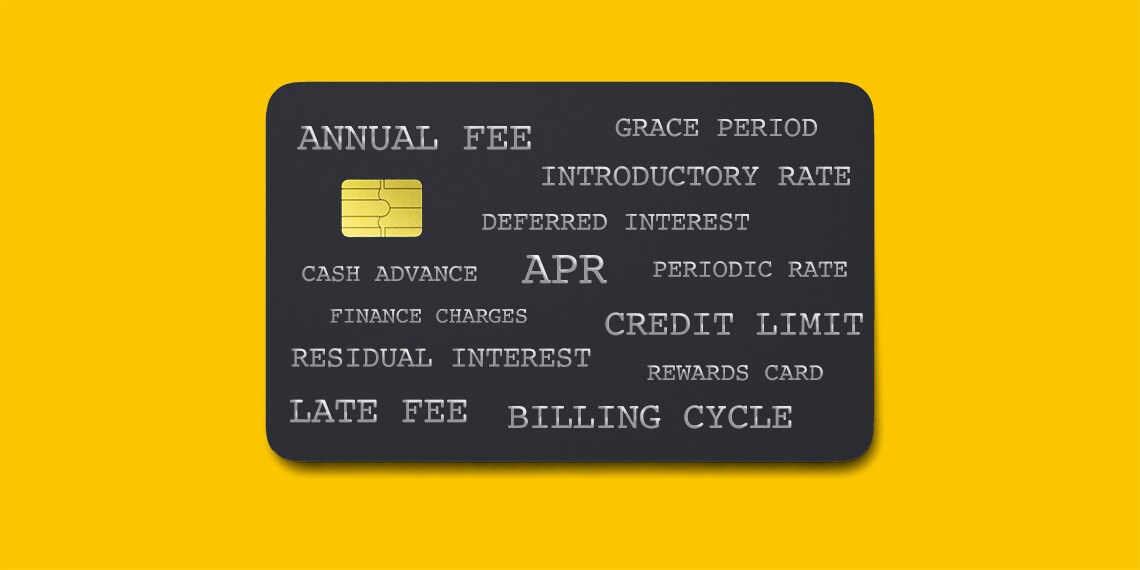
If credit card terminology sounds foreign to you, you’re not alone. Even though the average American adult has about four credit cards in their wallet, only 20% of cardholders can translate the terms of their credit card agreement. Learning some basic terminology, however, allows you to better understand how credit cards work—and ultimately helps you to be smarter about how you use your plastic. Here’s what you should know.
Annual fee: Some credit cards charge a fee each year for use of the card. This cost is in addition to any interest charged on balances carried beyond the due date. Cards that charge annual fees typically offer generous rewards, like cash back on purchases, airline tickets or other perks. Cards that carry an annual fee may also be the best available option for those who are just establishing credit or have a poor credit rating.
Annual Percentage Rate (APR): The yearly interest rate charged on money borrowed for purchases made is called the APR, and the average credit card APR is between about 17% and 24%. The credit card provider assesses this annual interest rate on all balances held after the due date. Each day, the amount you owe increases (1/365th of the APR on the balance) as the interest is added to your balance.
It’s important to note that your credit card may have more than one APR: One for purchases, another for balance transfers, and yet another for cash advances.
Balance transfers: Many credit cards offer lower interest rates for transferring the balance of another lender’s card to one of their cards. This can also be referred to as debt consolidation. Balance transfers may help you manage your debt more effectively by limiting late fees and lowering your interest rates.
Billing cycle: This is the period of time between monthly credit card statements. A billing cycle may run from the 1st to the 30th of the month, or from mid-month to mid-month. (Your credit card statement will outline the billing cycle and terms.) The schedule is important to remember, so you can time payments to avoid late fees or monthly interest charges.
Cash advance: In a pinch and need cash? Many credit cards provide an instant loan called a cash advance up to a specified amount, usually based on your credit history. Look on your credit card statement for your cash advance limit, which is a portion of your total credit limit. And if your credit card has a PIN, you can withdraw cash from an ATM, just like using a debit card.
Remember, however, that when taking a cash advance, interest rates may be higher than the interest rate charged for purchases made with your card. Also, there’s often no grace period for cash advances, so interest accrues from the day you take the advance. In addition, your financial institution may charge a transaction fee for each advance.
Credit limit: Each credit card comes with a maximum dollar amount of purchases you can make with it. This credit limit is determined by numerous factors, including employment history, credit score and the overall amount of debt you have accumulated elsewhere.
Deferred interest: Some credit cards offer a promotional option that allows you to buy now and pay later. With a deferred interest purchase, as long as you pay the debt in full within the time period provided, you won’t have to pay any interest. Minimal monthly payments are often required, depending on the terms of the promotion. But with deferred interest purchases, it doesn’t matter how many payments you’ve made; if you don’t pay off the balance of the purchase within the mandated time frame, you will owe the total amount of deferred interest. This is calculated on the balance you carried each month after you made the purchase.
Finance charges: Any fee charged for the use of a credit card is called a finance charge, which includes interest, late fees or fees charged for failure to make the minimum payment. Your credit card statement will itemize the finance charges you owe each month.
Fixed-rate APR: A fixed-rate APR (or fixed APR) sets an interest rate that doesn’t fluctuate with changes to an index such as the prime rate. This doesn’t mean the interest rate will never change, but that the card issuer must notify you before the change occurs. In most circumstances, the higher rate will apply only to purchases and other transactions you make after you get the notice.
Grace period: A grace period is a period of time when no interest is charged. This usually falls between the end of a credit card’s billing cycle and the payment due date. If you pay off the balance of your credit card in full on or before the due date, you won’t have to pay any interest. Grace periods are typically only for purchases—not cash advances.
Introductory rate: There’s no better way to get to know your new credit card than taking advantage of a special introductory rate. Many cards provide a low (even zero) interest rate on initial purchases for a limited amount of time. But keep in mind that once this introductory period is up, a higher interest rate kicks in.
Late fee: When you miss the due date for the minimum payment, many credit cards will charge a penalty, which varies from card to card. Cards commonly charge up to a $28 late fee the first time you miss a payment, and up to $39 if you’re late a second time within the next six billing cycles.
Minimum payment: Once you make purchases using your credit card, you’ll be required to pay a set minimum payment each month to avoid incurring late fees. This amount is typically within 2% to 5% of the overall balance at the end of the billing cycle, or a lower set percentage rate, plus a finance charge.
Periodic rate: Simply put, the periodic rate is your APR divided by 365 days. This is important because credit card interest is typically charged on a daily basis.
Residual interest: Just because you pay off your credit card balance doesn’t make you debt-free. This charge represents the interest that accrues between when your statement is issued and when you pay the bill. To make sure you pay your balance off completely, call your lender and request the exact “payoff amount.”
Rewards card: Many providers offer rewards points to encourage you to use their card. Savvy consumers shop for the rewards card that suits their needs and rack up points that they can redeem for cash, merchandise or travel. This perk is a smart way to maximize your spending power—especially when you pay off your balance every month.
Variable rate APR: A variable-rate APR (or variable APR) changes with the index interest rate, such as the prime rate. The cardholder agreement provides details of how a card’s APR can change over time, sometimes without the user being notified.
Brigid Galloway is a freelance journalist who writes about personal finance and healthcare for media outlets, including Marketplace and NPR.
Learn more about how the hidden benefits of your credit card.